


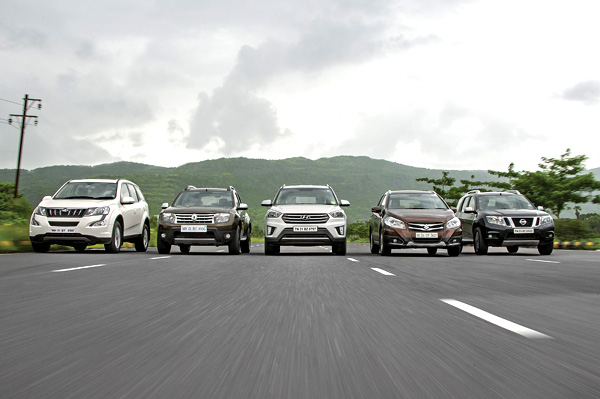
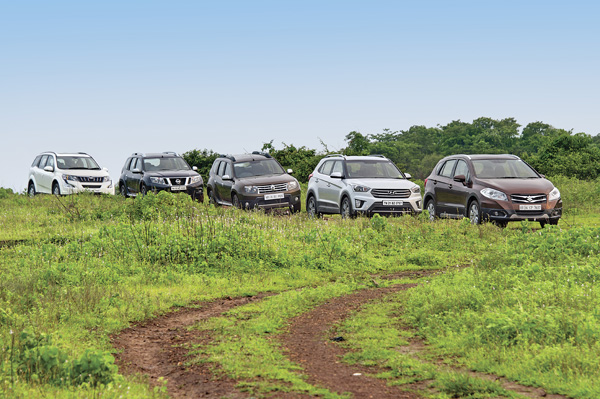
Going strictly by segmental classifications, these cars shouldn’t compete with each other. After all, one’s a crossover, one’s a large SUV and three fit the description of a small SUV. On paper, they are very different cars that should appeal to different sets of buyers. In reality though, these models operate in the same space and actually target the same buyer set. That they are also available in the same price band and with similar engine-gearbox options only strengthens the case to pit them against one another. Over to the contenders, then.
First up, we have the new S-Cross from Maruti. The S-Cross is unique for its crossover shape and is a model that Maruti promises offers a distinctly premium experience. For this test, we’ve taken the more powerful of its two diesel engine options. Then there’s Hyundai’s contender that comes in the form of the Creta. The overwhelming response to the small SUV suggests Hyundai has got it right but, an objective analysis will tell you if the hype are worth it. Here too, we’ve featured the more powerful of its diesel engines.
Of course, Renault’s popular Duster had to be here. Let’s not forget it is the model that really started the small (not compact) SUV revolution in India. With us for this comparison is the range-topping Duster AWD. Its cousin, the Nissan Terrano, is also one of our contenders. The Terrano may be a rebadged Duster but you’ll agree it’s got its own appeal. Finally, we have the Mahindra XUV500. It has been updated recently, and we're considering the front-wheel drive version.
Design and engineering
First and foremost, let’s just highlight that the XUV500 is the largest of the five cars here. At nearly 4.6 metres long, 1.9 metres wide and 1.8 metres tall, it really does look a class larger than its rivals. The S-Cross, Creta, Duster and Terrano are a lot closer to each other in size. They are all in the region of 4.3 metres long, 1.8 metres wide and 1.6 metres tall.
Still, despite the similarities in size, the S-Cross looks the smallest. The drooping nose, hatchback-like roofline and relatively soft contours are to blame for this appearance. Quite honestly, the S-Cross doesn’t have the same road presence as the other SUVs here. To be fair, Maruti has not once referred to the S-Cross as an SUV. But even judged as a crossover, the S-Cross is quite dull looking. At least, the plastic cladding and scuff plates are well executed and add some toughness to what is really a large hatchback.
The Hyundai Creta, on the other hand, is more traditional SUV in shape. It’s got a nice upright stance, the bonnet line is high and the thick C-pillar does add further solidity to the design. Styling too is restrained and mature. Nice bits include the neatly detailed front bumper, the blackened A-pillar that lends the windscreen a wraparound look and the smartly rising belt line. The tail, with its low-set number plate recess, looks a bit plain though.
Incidentally, plain is not a word you can use to describe the XUV500 that actually comes across as over-styled; and that’s despite a new nose. The 2015 car gets a toothy grille, more contoured bonnet and new headlights with Z-shaped LED light guides. Styling may be less of a mish-mash of varied elements now but details like the chrome shrouds for the new auxiliary lights on the front bumper look gaudy.
You won’t find such stylistic flourishes on the Duster or its twin, the Terrano. Detailing is simple and there’s a certain honesty to their shapes. Both do command attention though. The large wheel arches, muscular flanks and chunky C-pillars give them a strong stance. What’s nice is that the two have enough visual differences that you won’t confuse one for the other. Things that add to the Duster’s appeal include its blackened headlights, the blister effect near the tail-lamps and the AWD version’s smoked grey alloy wheels. The Terrano, with a nose that links it to Nissan’s own Pathfinder SUV and exclusive alloy wheels, looks special in its own right. Where both the Renault and Duster fail to impress is in their use of cheap, lift-to-open door handles; all others come with richer-feeling pull-to-open door handles. However, it must be said none of the five cars stand out for exceptional build quality. The Creta and S-Cross do come across as the best built though.
Each of these monocoque-bodied cars places its engine transversally with power channelled to the front wheels. When required, the Duster AWD additionally relies on a Nissan-developed electromagnetic torque converter to send power to the rear wheels. The Duster’s AWD system gives you the option to choose between two-wheel drive mode, four-wheel drive mode and ‘auto’ that automatically distributes torque based on available traction.
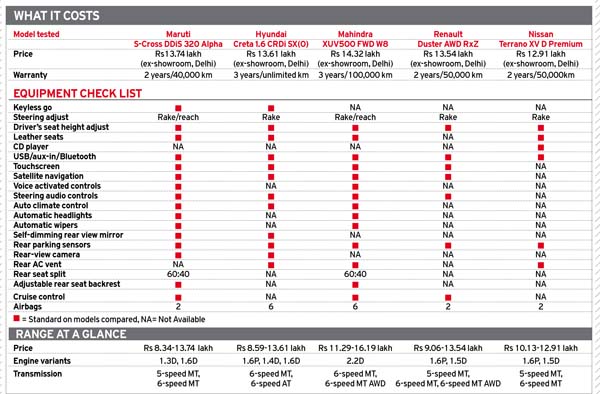
The Duster AWD and Terrano also differ in their rear suspensions. Where the Duster AWD, like the XUV500, features an independent, multi-link rear setup, the Terrano relies on a non-independent, torsion beam arrangement – something you’d find on the S-Cross and Creta as well. Up front, though, all of these cars use independent, MacPherson struts. Ventilated front disc brakes are the norm here but only the S-Cross and XUV feature discs at the rear too. What is heartening to know is that all cars except the base Terrano XE come with anti-lock brakes. While on the subject of safety, it’s important to highlight that the Terrano and Duster get a driver’s side airbag as standard while their top-spec versions get one for the passenger as well. The S-Cross, Creta and XUV feature dual airbags as standard, but the Hyundai and Mahindra can be had with as many as six. Also worth pointing out is that top versions of the Creta, XUV and Duster AWD come with the added safety of electronic stability control.