


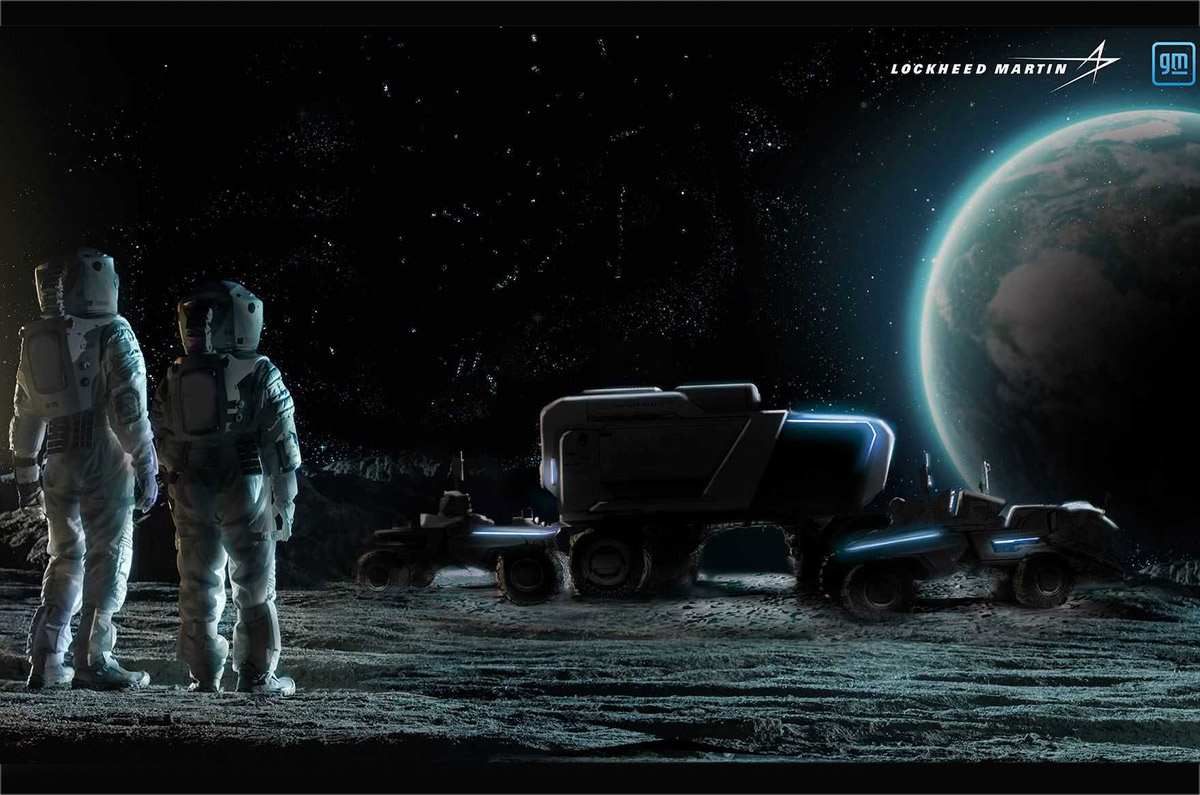

Lockheed Martin and General Motors are teaming up to develop the next generation of lunar vehicles to transport astronauts on the surface of the Moon, fundamentally evolving and expanding humanity's deep-space exploration footprint.
- These rovers will travel significantly more than the Apollo rovers
- GM will supply battery-electric technologies and propulsion systems
- The next-gen rover will be more capable in handling rugged terrain
NASA's Artemis program is sending humans back to the Moon where they will explore and conduct scientific experiments using a variety of rovers. NASA sought industry approaches to develop a Lunar Terrain Vehicle (LTV) that will enable astronauts to explore the lunar surface farther than ever before. The LTV is the first of many types of surface mobility vehicles needed for NASA's Artemis program.
GM and Lockheed Martin’s alliance
To support NASA's mission, the two industry leaders will develop a unique vehicle with innovative capabilities, drawing on their unparalleled engineering, performance, technology and reliability legacies. The result may allow astronauts to explore the lunar surface in unprecedented fashion and support discovery in places where humans have never gone before.
Lockheed Martin will lead the team by leveraging its more than 50-year-history of working with NASA on deep-space human and robotic spacecraft, such as NASA's Orion exploration-class spaceship for Artemis and numerous Mars and planetary spacecraft.
"This alliance brings together powerhouse innovation from both companies to make a transformative class of vehicles," said Rick Ambrose, executive vice-president, Lockheed Martin. "Surface mobility is critical to enable and sustain long-term exploration of the lunar surface. These next-generation rovers will dramatically extend the range of astronauts as they perform high-priority science investigations on the Moon that will ultimately impact humanity's understanding of our place in the solar system."
GM’s contribution to the space industry
GM is a leader in battery-electric technologies and propulsion systems that are central to its multi-brand, multi-segment electric vehicle strategy, positioning the company for an all-electric future. Additionally, GM will use autonomous technology to facilitate safer and more efficient operations on the Moon.
"General Motors made history by applying advanced technologies and engineering to support the Lunar Rover Vehicle that the Apollo 15 astronauts drove on the Moon," said Alan Wexler, senior vice-president of Innovation and Growth at General Motors. "Working together with Lockheed Martin and their deep-space exploration expertise, we plan to support American astronauts on the Moon once again."
GM’s history with NASA
GM has a proven history of supporting NASA and working within the space industry. The company manufactured, tested and integrated the inertial guidance and navigation systems for the entire Apollo Moon program, including Apollo 11 and the first human landing in 1969. GM also helped develop the electric Apollo Lunar Roving Vehicle (LRV), including the chassis and wheels for the LRV that was used on Apollo's 15-17 missions.
Unlike the Apollo rovers that only travelled 4.7 miles (7.6 kilometres) from the landing site, the next-generation lunar vehicles are being designed to traverse significantly farther distances to support the first excursions of the Moon's south pole, where it is cold and dark with more rugged terrain.
Autonomous, self-driving systems will allow the rovers to prepare for human landings, provide commercial payload services, and enhance the range and utility of scientific payloads and experiments.

 Viraaj Bhatnagar
 Uday Singh
 Suraj Viswanathan
 Lenny D'sa
 Saptarshi Mondal