
Until now, fuel cell EVs have primarily been about sustainability. Unlike battery EVs, of which there are plenty of ultra-rapid examples, it will be a while yet before mainstream hydrogen cars appear in significant numbers, but UK engineering firm WAE Technologies is ahead of the game with its 582hp EVRh.
Revealed at the Cenex Low Carbon Vehicle show recently, the EVRh is a high-performance car architecture designed to show off FCEVs’ capabilities.
Fuel cells are good at delivering a steady flow of electrical power, but not so good at delivering the sudden bursts of power needed for acceleration. For that reason, FCEVs have a buffer battery to power their motors, which is kept topped up by the fuel cell stack. The EVRh is a parallel hybrid, so both the battery and the fuel cell stack can feed power directly to the motors via a controller.
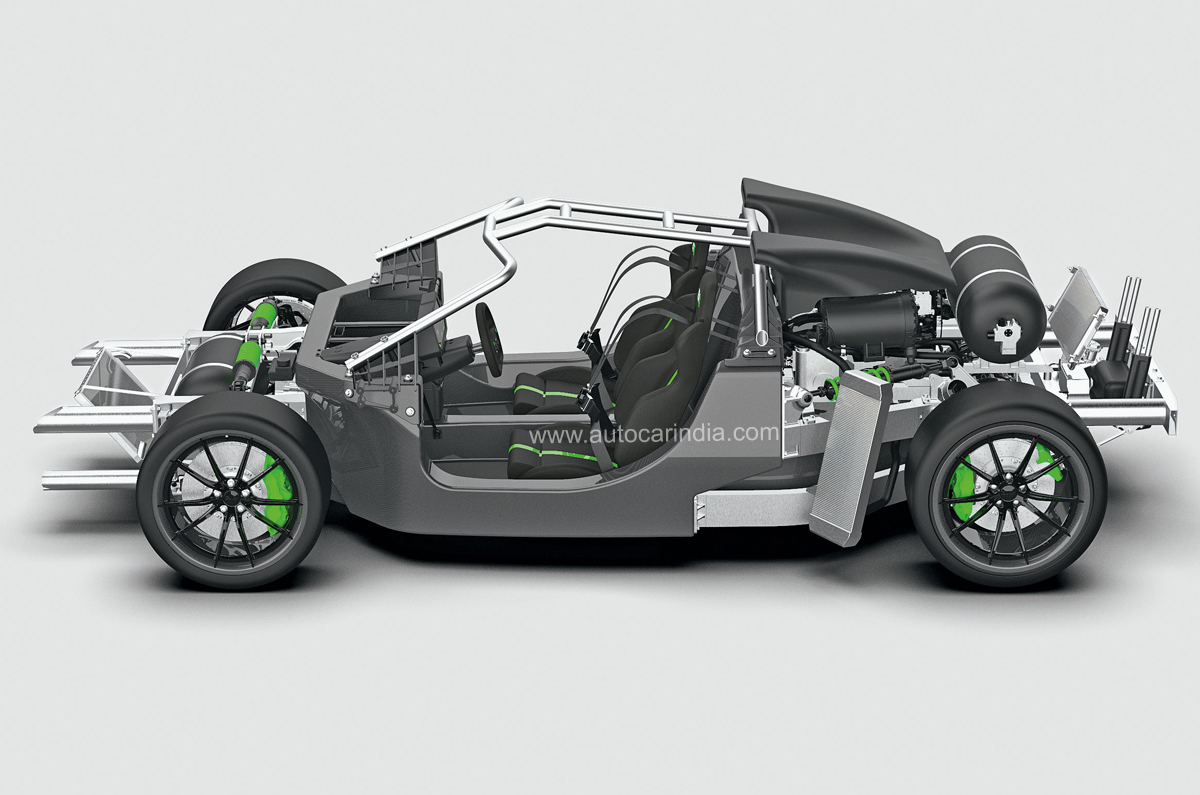
WAE calls the power unit an ‘FCEV battery pack’ as a nod to its integrated design. The best way to think of it is as a hydrogen-electric engine, only without any moving parts. The power unit and hydrogen tanks are mounted centrally in the car to give it a low centre of gravity and even front-to-rear weight distribution.
The EVRh is a lightweight composite structure with a rigid central tub, capable of supporting track-only or road-going roadster, Targa and fixed-roof coupé bodies; and a rear-wheel-drive or four-wheel-drive layout, with a choice of motor configurations. The liquid-cooled ‘power unit’ can supply a maximum 430kW (584hp) of energy to the motors, with the fuel cell providing 120kW of charge power.
The whole package weighs less than 1,900kg and can accelerate to 100kph in less than 2.5sec. WAE estimates the car is capable of turning in a Nürburgring lap time of under 7 minutes 20 seconds. And despite such high performance, the range is quoted as an impressive 599km.
The EVRh is a sister concept to the battery-electric EVR, which WAE revealed in September 2022. Like the EVRh, the EVR was designed as a turnkey platform for start-ups and established manufacturers. It has an 85kWh battery pack producing a massive peak power output of 1,650kW (2,242hp). A tad lighter than its hydrogen-powered sister, at 1,800kg, it can hit 100kph in less than 2.0sec and has a potential top speed beyond 399kph.
Underpinning both architectures, and perhaps what makes them stand out, is WAE’s track record (literally) in advanced battery technology. It has supplied batteries for Formula E since 2014 and more recently Extreme E.
Earlier in 2023, it revealed the Cell2Pack battery, designed to form a structural part of the chassis and be a turnkey solution for low-volume manufacturers.
It also showcases its Scalable Battery Module, again aimed at low-volume and niche manufacturers. Designed to do away with the replication of electronics in a battery, this ‘toolkit’ technology makes it faster and easier to develop bespoke batteries for individual projects.