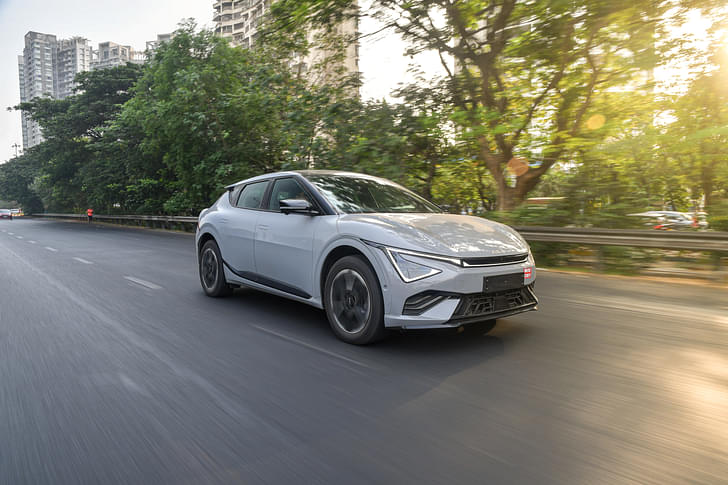



The Kia EV6 facelift was recently launched at Rs 65.9 lakh (ex-showroom, India). Apart from some styling changes and tech upgrades, the biggest update is the introduction of a larger 84kWh battery, replacing the older 77.4kWh unit. We have subjected the EV to our real world range tests to see just how efficient it really is.
- Tests were done in the Eco drive mode
- EV6 facelift has a claimed range of 581km (WLTP)
- Gets four levels of regen braking, including a one-pedal mode
Kia EV6 facelift range, real world efficiency
The new 84kWh battery pack, which, like its predecessor, uses NMC chemistry, is not only more energy-dense but also claimed to be lighter than the one it replaces. As such, the claimed range has gone up to 581km (WLTP), up by 53km from before.
Impressively, under real world conditions, we managed to achieve a combined range of 498km, which is close to the official figure. City driving yielded an efficiency of 5.18km/kWh, which translates to a usable range of around 435km. Interestingly, highway efficiency was even better at 6.67km/kWh, delivering a range of approximately 560km.
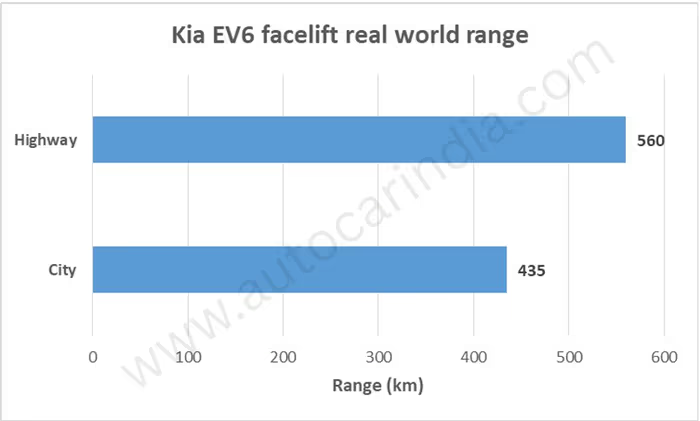
It’s worth noting, however, that ambient temperatures rose by approximately 12 degrees during our city run, which meant the AC had to work harder to keep the cabin cool, impacting efficiency. Also, while we used Level 3 (four levels in total) regen braking in the city, it wasn’t strong enough to recoup enough charge or bring the EV to a complete halt.
Autocar India’s range testing
Before our real world range test, the battery of our test car was fully charged, and tyre pressures were set according to the manufacturer’s recommendation. The car was driven in Mumbai city and on the adjoining state highway, on a fixed loop on a weekday, and we maintained the set average speeds. At the end of each cycle, we calculated the range based on the percentage of charge consumed. Throughout the test, the climate control was set to 22°C in full-auto setting, and other electricals like the audio system, indicators, and ventilated front seats were used as needed, just like a regular user would. We take pride in our testing data, which is not only consistent but also gives users an accurate indication of what they can expect in the real world.