

Nissan has improved on the production process for carbon fibre reinforced plastic (CFRP) parts allowing for faster manufacturing. Currently used in airplanes, rockets and sports cars, Nissan aims to use the new process to mass-produce CFRP parts and introduce them in more cars for customers.
- Revised process speeds up development time of CFRP parts
- Uses Computer Assisted Engineering to simulate parts of the process
- Carmaker aims to use CFRP parts in more of its future cars
The revised process speeds up the development of car parts made from carbon fibre reinforced plastics, or CFRP.
How has Nissan sped-up the development process?
Nissan found a new approach to the existing production method known as compression resin transfer moulding. The existing method involves forming carbon fiber into the right shape and setting it in a die with a slight gap between the upper die and the carbon fiber. Resin is then injected into the fiber and left to harden.
Nissan’s engineers have used Computer Assisted Engineering to accurately simulate the permeability of the resin in carbon fibre, while visualizing resin flow behaviour in a die using an in-die temperature sensor and a transparent die. The result of the successful simulation was a high-quality component with shorter development time.
This method can cut the lead time to develop CFRP components by as much as half, and the cycle time for moulding by about 80%, comparedto conventional methods.
Why is carbon fibre beneficial and why aren’t carbon fibre parts mass produced?
Lightweight yet extremely strong, carbon fiber reinforced plastic can be used to make cars safer and more fuel efficient. It can also lower a car’s centre of gravity when applied to upper body parts, making it more agile and exciting to drive.
While the benefits of carbon fibre have long been known, it’s expensive compared to other materials such as steel. Along with the difficulty in shaping CFRP parts, the cost has hampered the mass production of automotive components made from the material.
What’s to come from Nissan India?
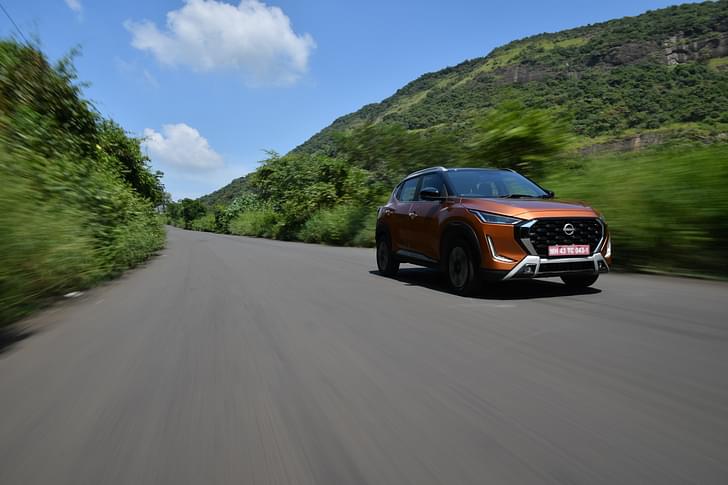
Shifting focus to the Indian market, Nissan is currently gearing to bring its all-new compact SUV, the Magnite to market next year. Revealed in concept form in July, the production of the compact SUV is expected to look quite similar to the former. Engine options will include a naturally aspirated 1.0-litre engine good for 72hp and a turbocharged 1.0-litre petrol unit putting out around 96hp.

 Viraaj Bhatnagar
 Uday Singh
 Suraj Viswanathan
 Lenny D'sa
 Saptarshi Mondal