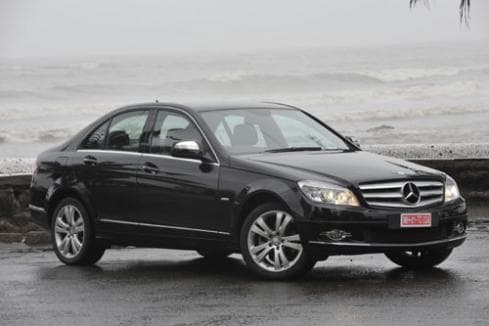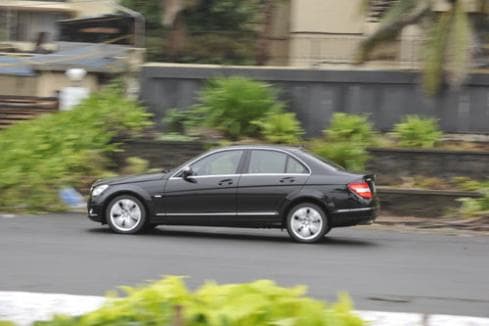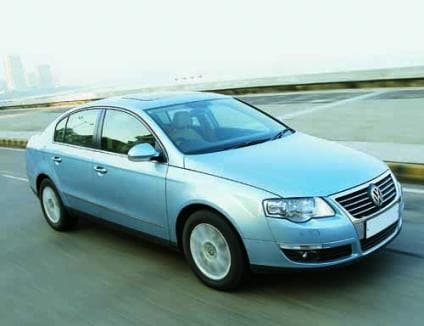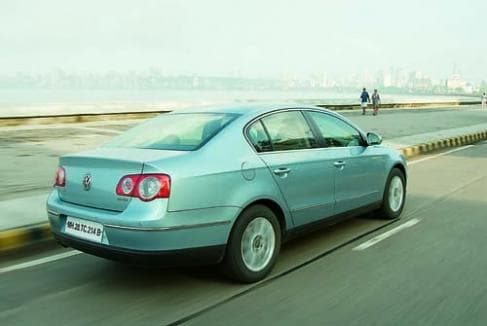

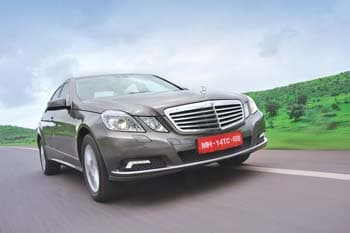
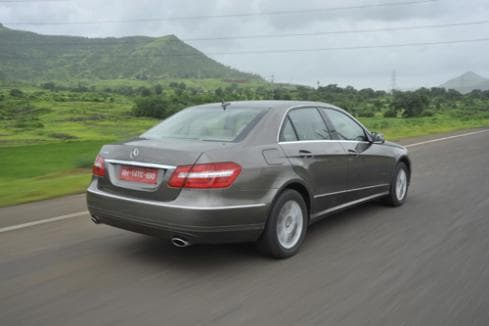
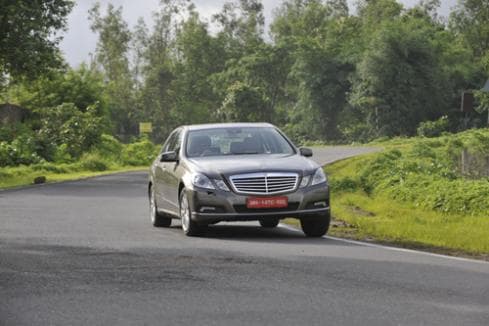
Unlike the outgoing E-class (W211), which was an evolution of the car that preceded it (W210), the latest E-class (W212) is quite a radical departure from the rounded and softer lines of the car it replaces. The bulge over the rear wheel arch stretching into the wings is a throwback to Mercedes models of the 1950s, while the four-headlamp front, a feature of the past two generations of the E-class, has been given a new twist. Mercedes says the headlamp design is meant to give the look of precious gems pressed into the wings. We think the look is a touch contrived. What looks great are the standard daylight running lights next to the fog lights.
The Avantgarde model gets LED bulbs set in a boomerang shape. A more upright grille with a more pronounced V-shape makes the new E look more assertive. At the rear, the winged lights are quite dramatic and the crease on the centre of the boot lid is quite prominent. Dimensionally, the new car is longer (by 16mm) and wider (by 32mm) and lower (by 10mm) than the outgoing W211 but the erect and rather formal styling gives the impression that it is substantially larger. Despite the squared-off styling, Mercedes has achieved a drag coefficient of just 0.26 which is highly creditable.
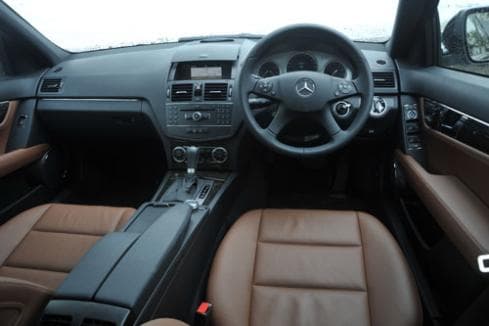
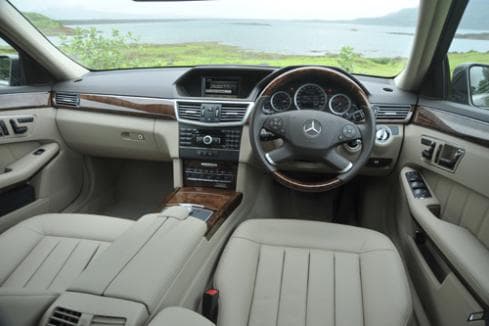
Step inside the new E-class and the immediate impression is of understated quality. It has precise switchgear and lots of soft-touch plastics although some materials and textures like on the steering boss don’t feel very special. The beige interiors have a shade of brown which is not to our liking; we feel the E-class looks best and classiest with black interiors, which is also an option. The ‘waterfall’ lighting effect which splits the dashboard and the downlighting on the door switchgear looks simply fantastic at night.
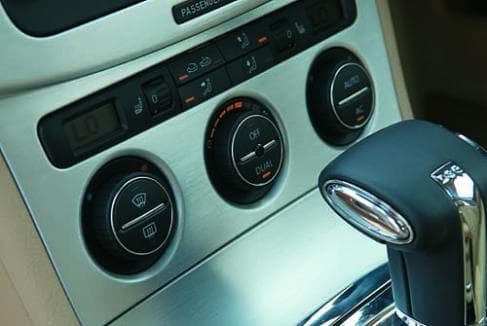
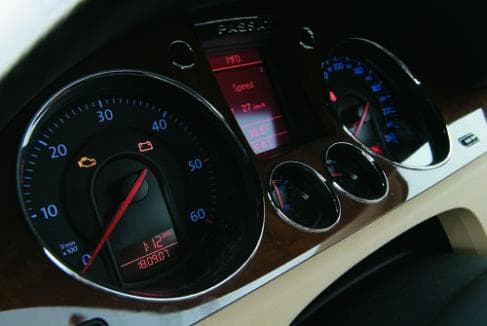
The dashboard is upright with angles and straight lines instead of the flowing shape of the previous E-class. Taking pride of place is the high-mounted screen housed in its own binnacle. A single knob lets you scroll through the on-screen menus to operate most functions. The stereo and climate control systems get conventional controls and the mass of tiny buttons that surround them can be quite confusing.
The best news is that Mercedes has finally agreed to give the E-class fully-powered seats. The sound system is beefed up, parking sensors are standard and so are cornering lights. And, of course, safety too is enhanced with more airbags than before and a unique Attention Assist system which detects drowsiness and gives a warning!
The E-class is powered by a silky smooth four-valve per cylinder, twin-cam 3498cc V6, the same which powers the current S-class. This 272bhp provides more than enough grunt for the E-class, which is significantly lighter than the S-class (by 145kg). The throttle response is sharp has an urgency that will delight owners.
Mash your right foot into the carpet and the big E lunges forward, acceleration always strong and linear. It’s deceptively quick as well and wafts you to 160kph in under 20 seconds before going on to a claimed top speed of an astonishing 250kph. The engine is super silent and even at max revs, there’s just a murmur from under the bonnet.
Even more impressive is the seven-speed, 7G-Tronic ’box. Equipped with paddleshifts, plus-minusing is a joy and the revelation of this gearbox is the aggressive way in which it downshifts. The Merc’s seven-speeder drops a gear more readily and you feel the effect of ‘engine braking’ just like in a conventional manual. Driving in ‘D’ (which is what most owners will do) isn’t bad either, the ’box very responsive and the kickdown pretty quick. The options of ‘Comfort’ and ‘Sport’ mode, standard on Mercs for a while, tweak the shift pattern with the latter mode shifting gears with a bit more urgency.
A big V6 petrol engine in a 1.7-tonne car isn’t going to be economical but the E350 could have done worse. The city figure of 6.3kpl is in line with our expectations, especially since stop-start conditions with all that mass can make the engine quite thirsty. The insanely tall seventh gear allows the car to cruise at very low revs, which helped achieve an impressive 11.4kpl.
At the heart of the new E-class’s brilliant handling is Mercedes’ variable ratio Direct Steer system. It is a brilliant combination of being perfectly weighted (not too heavy and not too light) accurate and blessed with good feel. The new E darts into corners with lots of enthusiasm and little body roll. The harder you go, the tauter the handling gets which allows you to place this big saloon precisely and directional changes are dealt with confidently. The two-stage hydro-mechanically self-adjusting dampers offer a supple ride for relaxed driving and a stiffer set-up when you want to barrel into corners.
The variable steering system cuts steering lock by almost 15 percent and the turning circle too has been shaved by 15cm, allowing you to more confidently negotiate city traffic and parking. When roads are at their worst, the E-class glides over the worst surfaces with barely a jolt filtering into the cabin. The damping is well judged making the car feel very pliant. The brakes were outstanding and offer significantly better feel with none of the previous system’s mushiness.
 Soham Thakur
 Lenny D'sa
 Sergius Barretto
 Nikhil Bhatia
 Saumil Shah